
 Wedneyday 28 January 2026: 1st International online Jenaplan Conference. At the start of her keynote, the Austrian Jenaplan expert and professor of innovative pedagogy, Susanne Herker, greeted her international audience from twelve countries. While Europe had just begun its working day, Jenaplan teachers in Japan and Taiwan were at the end of theirs and participants from the America’s were logging in around the midnight hour. Susanne started on a gloomy note, pointing out the various global crises having their influence on education. However, she portrayed Jenaplan pedagogy as a moral compass to guide the way through this maze: a 100-year-old answer to provide crucial attitudes, knowledge and skills for our times as identified by OECD and WHO. Read this written, slightly expanded, version of her keynote.
 What should education be in this rapidly changing world?
As educators in the 21st century, we are very much challenged by rapid changes, both in our world at large and in education itself. Some changes have a direct impact on the school world: digital developments for instance may help teachers, yet they can also easily undermine their specialist authority. Other cultural and societal shifts have had a more gradual influence on our schools and our pedagogical professionalism, for instance when more diversity, more personal family lifestyles, more opinions, more outlooks on life are gathered into our classrooms. Similar developments are occurring on every continent.
Current-day discussions around basic questions such as ‘what is education?’ and ‘what should we teach our children?’ immediately touch on a wide variety of topics, ranging from new perspectives on what is canonical knowledge that a curriculum should address, to new competences necessary to approach artificial intelligence responsibly.
'For a healthy development towards personhood and a sense of belonging, children need an optimistic, hopeful, constructive educational environment.'
These discussions are part of a larger global perspective in which we experience several interlinked crises that seem to become more numerous and unsolvable every day. In German, the phrase ‘Katastrophen-Kindheit’ (‘Disaster Childhood’) has been coined, from which children need to be protected, otherwise trauma may result (e.g. Karutz et al, 2023). For a healthy development towards personhood and a sense of belonging, children need an optimistic, hopeful, constructive educational environment.
 Learning to live together
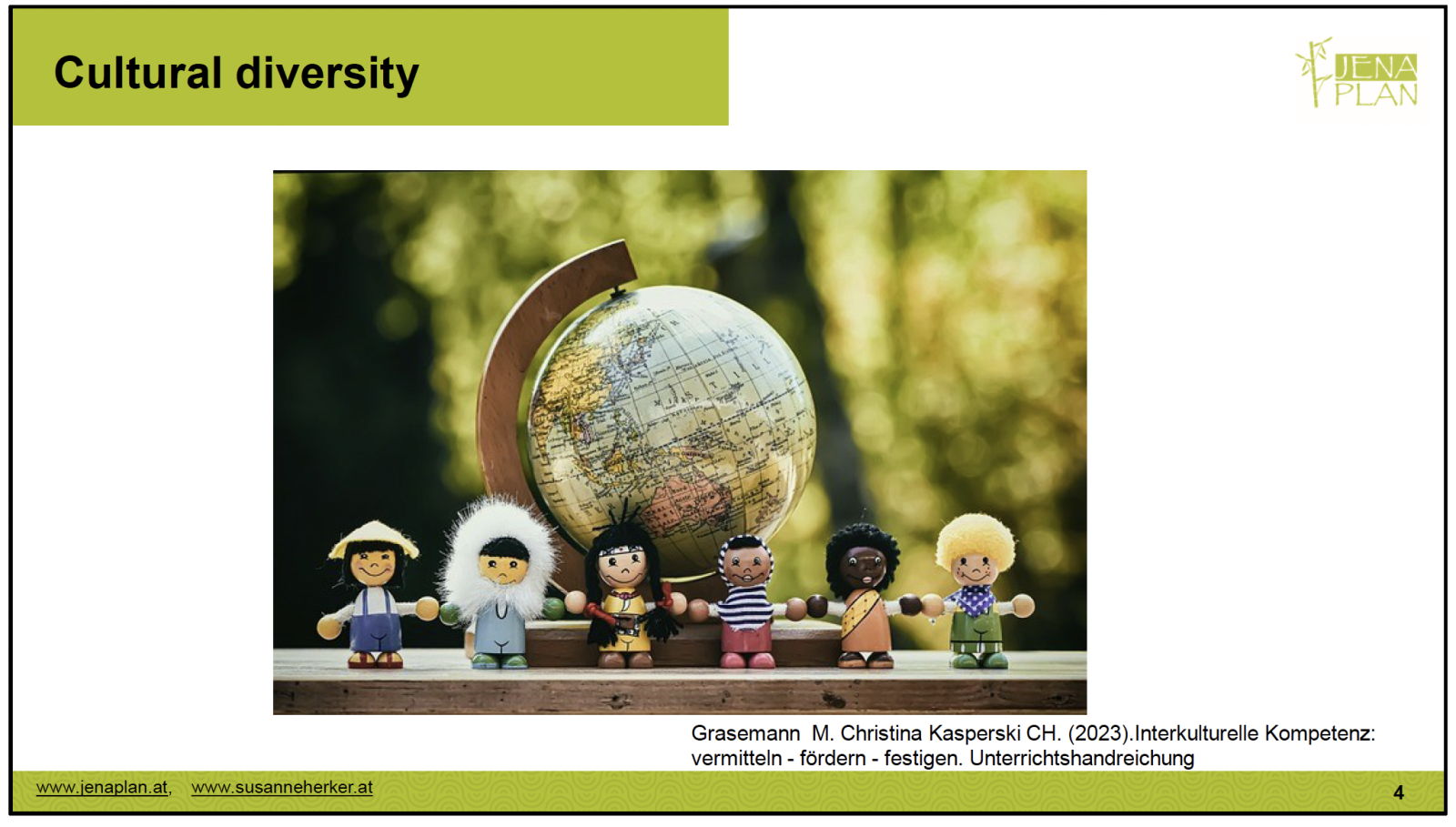
In Europe, diversity in the classroom has increased enormously over the last two decades (see for example Grasemann & Kasperski, 2023). Children of different ethnic groups and religious denominations, from different family arrangements and from parents with diverging political-societal views, all find their seats in our classrooms, where they are expected to learn and live together. This constellation can no longer be managed with teacher-centred education without an open and honest space for the active participation of the children. These challenges require a pedagogy in which different opinions and points of view are invited, heard, discussed and evaluated together.
'These challenges require a pedagogy in which different opinions and points of view are invited, heard, discussed and evaluated together.'
Digital developments are progressing so rapidly that teachers are often surpassed by the dexterity and skills with which young people make use of them. On the other hand, young learners usually lack a fully developed a sense of critical awareness and responsibility, and may easily fall for digital seductions, for example filter bubbles or digital addiction. Protecting, educating and strengthening children with regards to these developments has also become a major task for educational institutions (Hajok, 2025).
Communication has changed due to social media – both with hazardous and with great results: our international online conference being an excellent example of the possibilities. However, the basic need of people, not least children, is still to meet each other ‘in real life’ and experience personal resonance. Honest face-to-face communication must be cultivated through differentiated forms of communication. In these ways, children learn to voice and exchange opinions, to explore the factual content of their ideas, to receive and give honest feedback without being hurtful (Wampfler, 2018).
The question arises again and again: how can and should schools respond to these challenges? And, more practically: what kind of teaching or learning environment can and should schools offer? Jenaplan with its layered ways of organizing classroom interactions and its pedagogical goal of ‘learning to live together’ provides one such answer. In 1937, Peter Petersen already wrote in his Leadership Theory of Teaching: "The time of simply using methods is probably over” (Petersen, 1937/1984, p. 13.).
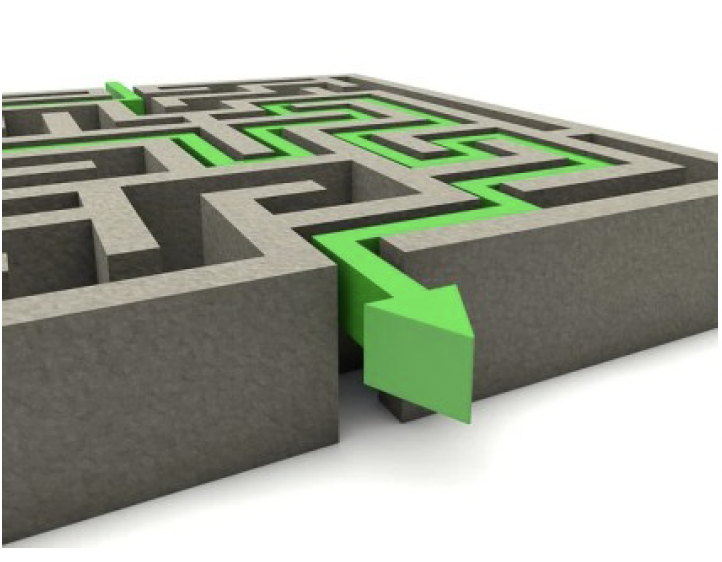
 Finding your way through the maze
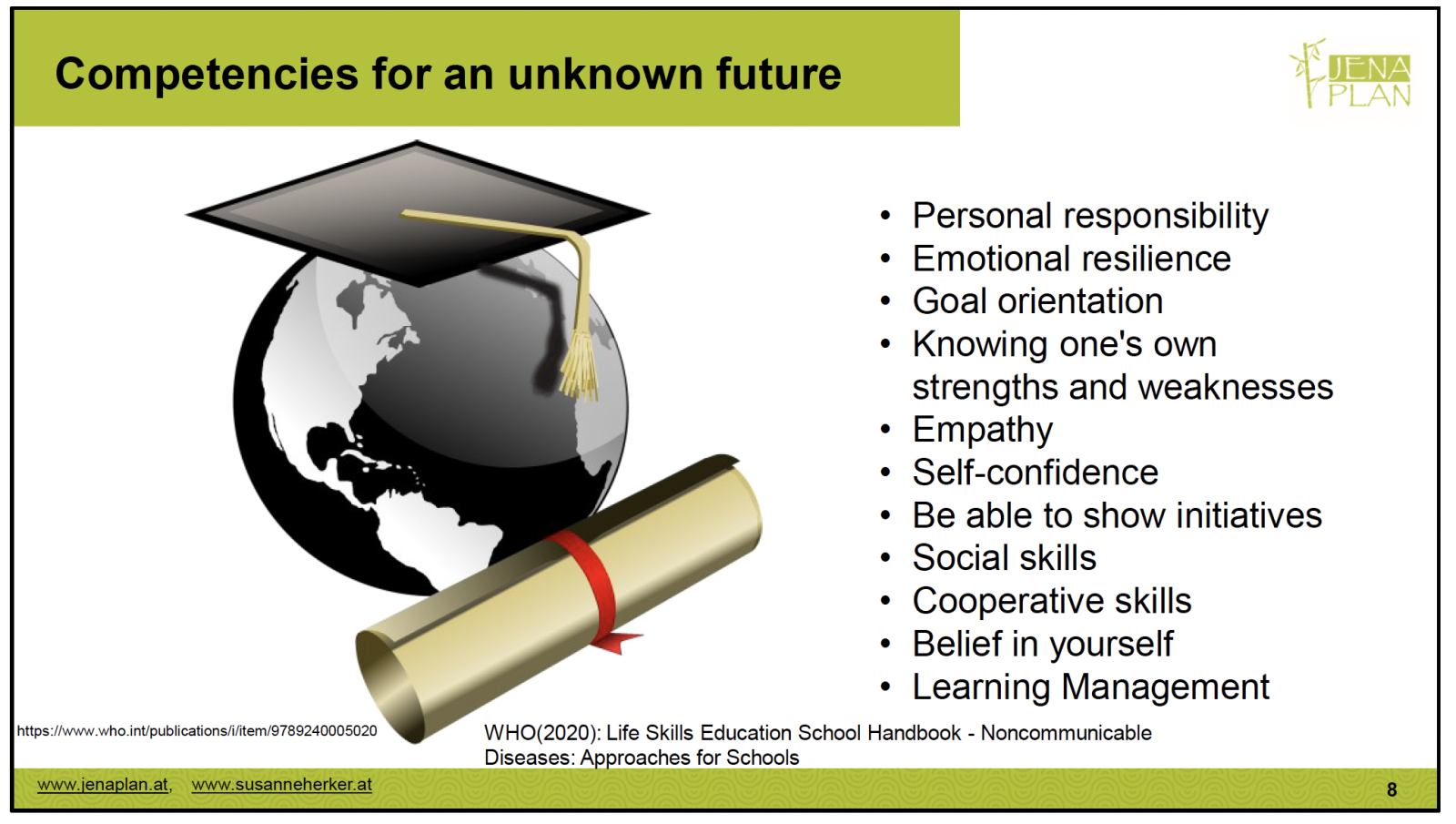
The World Health Organization (2020) has compiled a list of life skills that are indispensable for a self-determined life in our time. The organization has defined life skills, as “abilities for adaptive and positive behaviour, that enable individuals to deal effectively with the demands and challenges of everyday life.” (p. 1).
These includes the will to take responsibility; emotional resilience; a goal orientation so that personal long-term as well as short-term goals can be achieved; every young person should be able to name their own strengths and weaknesses without always having to compare themselves with others. Self-confidence is an essential building block to lead a well-rounded life. The ability to cooperate and critical thinking are also part of it. Last but not least, the belief in oneself and various methods for lifelong learning are necessary to shape one's life independently of others.
In many publications, Jenaplan education has been analysed with the conclusion: it offers a possible way through and out of this maze. Successful pedagogy must offer an orientation on contemporary life. The dynamics of ‘orientating’ yourself and your students towards something, entails more than bringing across ‘dry’ factual knowledge. It should offer an overview of the fundamentals – that which Peter Petersen called ‘elementary grammar’ – and in addition it should be able to work towards answers to the how and why: to why things are the way they are and how they were shaped by nature, by people, by circumstances.
Such an orientation is never one-dimensional; rather, it offers explanations from multiple perspectives and it translatable into other contexts. For this, one-dimensional top-down teaching on the part of the teacher does not suffice. Learners are invited and stimulated to contribute by bringing their own curiosity and their questions into the ‘pedagogical situation’. Jenaplan teachers – better known as stemgroupleaders – may intentionally introduce contradictions and diverse perspectives into the conversation, for them to be examined and discussed. The textbook as the only source of knowledge is to be rejected.
 What we should focus on in our education
1. World Orientation
Peter Petersen already spoke of ‘world orientation’. He wanted learners to work on their questions and use them to explore the world. Factual knowledge is certainly not dismissed, but it is oftentimes arrived at exploringly, thinkingly, and therefore more vividly and more experientially. Through a thematic orientation, knowledge is studied and learned in living contexts. Jenaplan pedagogy is thus very much in line with concepts of global learning.
'The stemgroupleader ensures that there is a framework for the learner to thrive.'
This is not to say that stemgroupleaders set their children free willy-nilly to explore the world unsystematically. Rather, educational work must set anchors for children, especially by providing support in unsettling times. The stemgroupleader is a person of trust who must provide material, technical and emotional support during the learning process. The stemgroupleader ensures that there is a framework for the learner to thrive, that there are age-appropriate learning materials and there is a structure to the dynamic participatory learning process. It is by no means a matter of constant ‘testing and evaluation’, but of ‘accompanying’, ‘stimulating’, ‘challenging’ and ‘supporting’. Above all, a great emphasis is put on serious, thorough feedback. In Jenaplan pedagogy, the stemgroupleader often takes the role of a learning companion, but according to Petersen, he or she does carry the ultimate responsibility.
 2. Building resilience
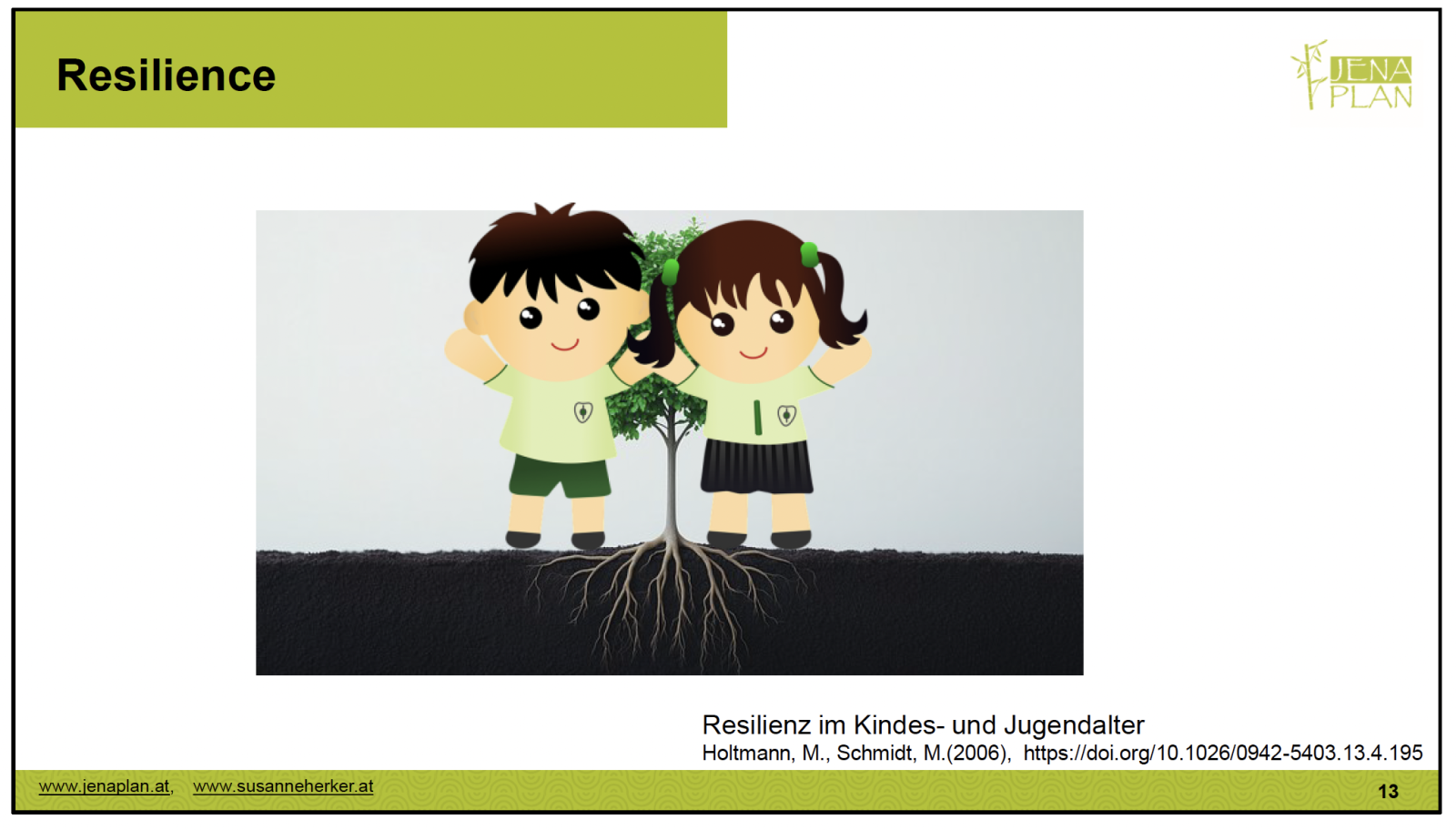
‘Resilience’ is the resilience of the soul. The term resilience describes a dynamic or compensatory process of positive adaptation in the face of significant stress (Holtmann, & Schmidt, 2006). Resilience is a vital character trait, especially in turbulent times, and we know that life is always full of challenges that don't always end well. Therefore, adolescents need the safe pedagogical environment of their schools to learn to deal with adversity and setbacks. Resilience is built over time: children need to grow firm roots, and we do so by stimulating them to try and by helping them to start again, when they make a mistake. Children become resilient by means of our ongoing support, not by keeping them out of harm’s way nor by doing the work for them. Failures are part of learning: the right emotional accompaniment makes them strong so that they do not despair or stop trying. Psychologists cite frustration tolerance and emotional regulation as essential elements for a happy life.
'Children become resilient by means of our ongoing support, not by keeping them out of harm’s way nor by doing the work for them.'
3. The individual and the community
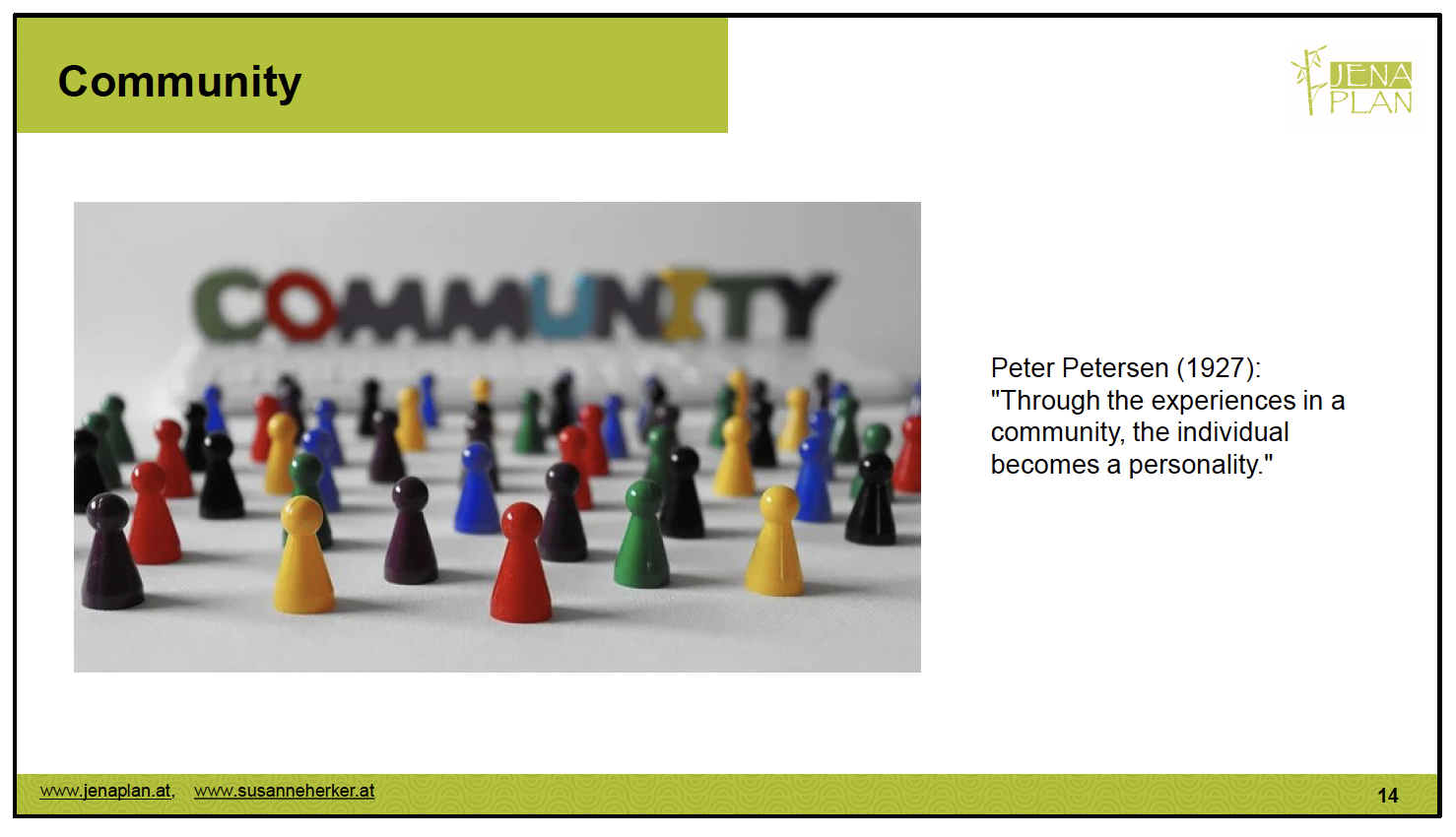
Another key concern in Jenaplan pedagogy is the group, the community. Knowing that they are accepted into a safe and caring community is an essential and enriching experience for every young person to grow and flourish. Precisely this is what Petersen set out to do at the start of his Der Kleine Jena-Plan: his aim was to create a pedagogical, educational community in and through which a child can develop its individuality into a personality (1927). In a similar vein, the 54 articles in the UN-Convention on the Rights of the Child (1990) guarantee that children are guided to be fully prepared for an individual life in society.
 Four recognisable elements in any Jenaplan school
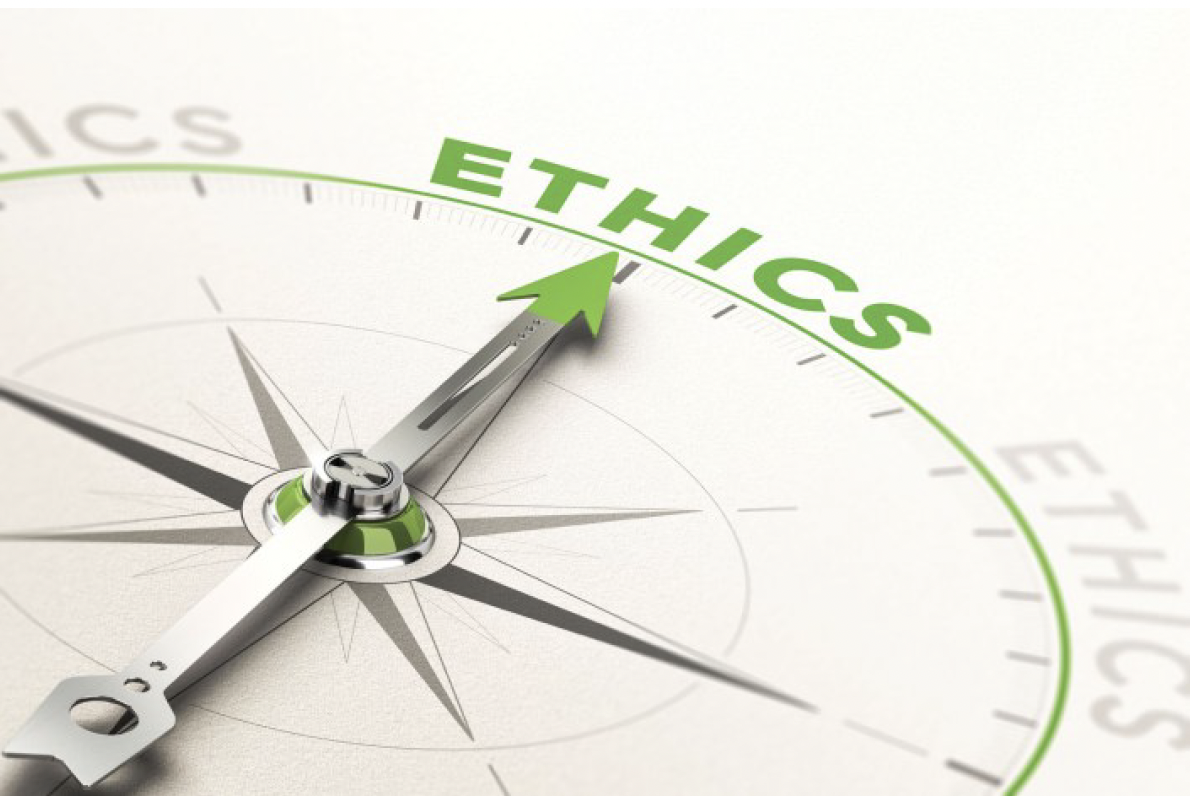
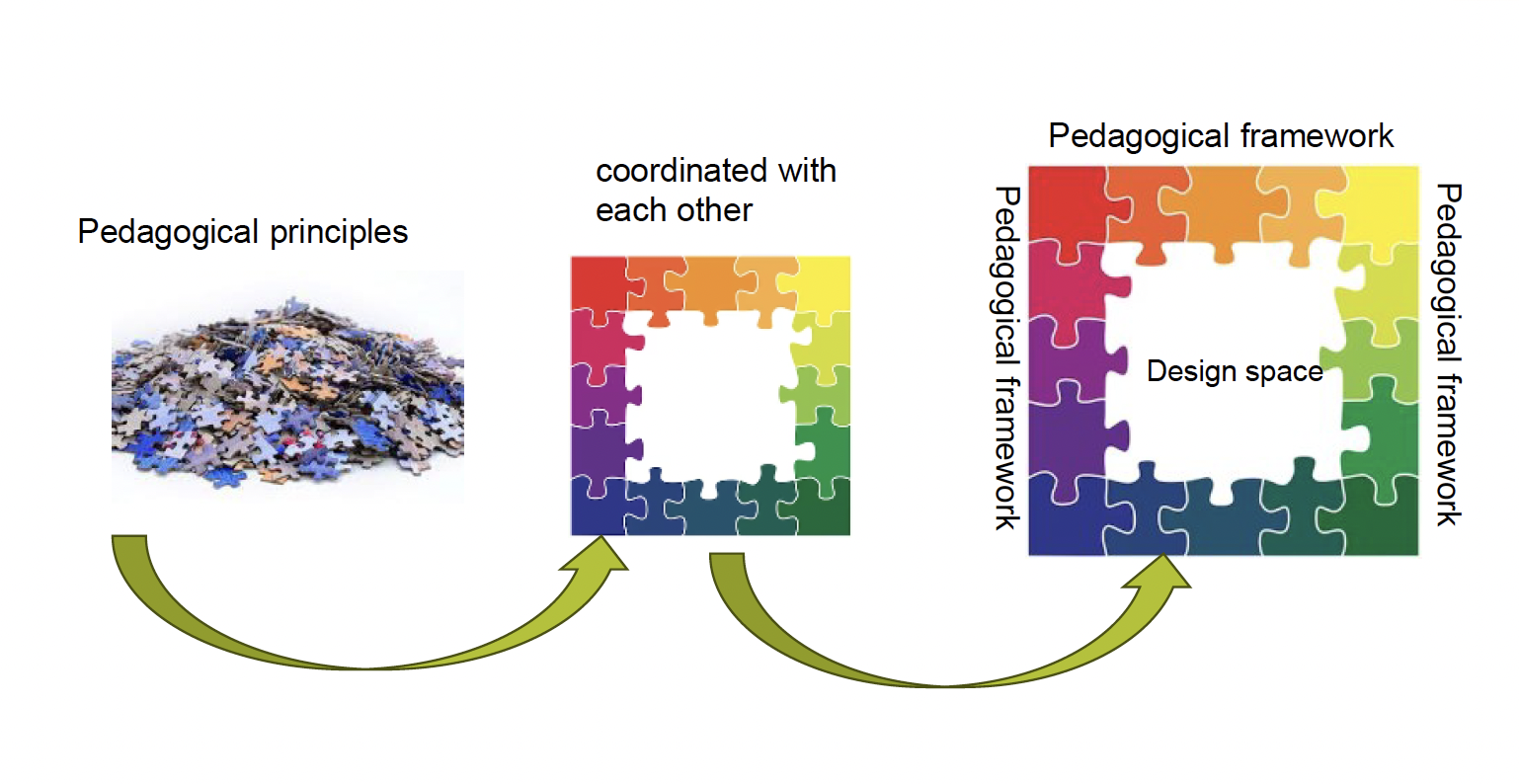
What is striking about Jenaplan pedagogy, is that Petersen has not filled in all the details in his concept. He has provided clear pedagogical principles and stipulated certain structural and practical elements, such as the rhythmic weekplan and the circle, but they are merely a framework for the day-to-day school life and the school development over time. Within this framework, each teacher and each school is actively invited to bring in their own local context, judgements and decisions, at their own pedagogical discretion. Hence, schools and individual stemgroupleaders are required to actively engage with the concept in past, present and future. This is what gives this pedagogy its strength: on the one hand, it has a solid pedagogical foundation, but on the other hand, it provides the possibility to create a school for your community: no two Jenaplan schools are the same, but underneath the different shapes, the pedagogical principles will be recognisable, as a pedagogical compass.
'This is what gives this pedagogy its strength: on the one hand, it has a solid pedagogical foundation, but on the other hand, it provides the possibility to create a school for your community: no two Jenaplan schools are the same.'
1. The balance between structured course work and exploratory learning
Let us briefly explore some of these recognisable elements that underlie the structure of Jenaplan pedagogy. The farmer’s son Peter Petersen used the agricultural metaphor of taking good care of both the ‘fields’ and the ‘farming tools’. Children will not know what to do, when invited to explore a certain theme in world orientation (‘the fields’) if they are not provided with the proper tools to do this exploration. Therefore, in Jenaplan education there is an emphasis on course work. Course work is offered during the school day in teacher-centred instruction phases, geared to learning objectives, stringently structured. The focus is on acquiring basic skills, techniques and knowledge, such as reading, writing, calculating, fundamental social-cultural knowledge and meta-cognitive knowledge on how to learn. Besides ‘course work’, there is the ‘core’ of world orientation: children learn beyond the rigid boundaries of separate subjects (such as biology or geography). In project-oriented learning, networked thinking is stimulated, as well as collaborative work, project-oriented.
 2. Classroom participation: the voice of the stemgroup
A second recognisable element in the structure of Jenaplan pedagogy is classroom participation. The children’s ‘student voice’ is actively invited to co-determine the contents and methods used in their stemgroup. They participate in the development of themes and topics, for instance by brainstorming, mindmapping and collecting and ordering their research questions. The children’s honest and open reflections and feedback are also part of the process. In a well-organised stemgroup, in which different age groups and developmental levels come together, Petersen saw that children could variously take on the roles of ‘apprentice’, ‘journeyman’ or ‘master’: a child with an advanced knowledge in for instance reading or mathematics is invited to become a ‘tutor’ for another child, who still has difficulties mastering the subject. In that way, both children learn, because the tutor will truly master the skills and knowledge by teaching it. Lastly, children participate in both independent work as well as cooperative learning.
3. Curious questions as our starting point
A third element is the space that Jenaplan offers to curiosity and the sense of wonder. Children’s questions are at the core of our education, and stemgroupleaders probe their children by asking open questions to which they themselves may not even know the answers. As James Thurber, American author and contemporary of Petersen, is often quoted: ‘It is better to know some of the questions than all of the answers’. Without asking yourself questions, true learning is hardly possible. Children have so many questions about themselves, others and the world around them. Therefore, Jenaplan pedagogy takes the children's curiosity seriously by using it as a motivational motor and by making it the starting point of their learning process.
'Jenaplan pedagogy takes the children's curiosity seriously by using it as a motivational motor and by making it the starting point of their learning process.'
4. Pedagogical situations: the whole stemgroup switched on
Lastly, Jenaplan pedagogy starts from ‘pedagogical situations’. Petersen’s developed this notion based on the existentialist philosophy of his time. In a pedagogical situation, the stemgroupleader taps into the sense of wonder of the children and offers further impulses to their initial questions in such a way that all children become active and are ‘switched on’ to what is happening. From this heightened sense of curiosity, the children feel deeply connected to the topic, the object, the phenomenon that is about to be explored. In academic observations, we have shown that the children’s inquiries oftentimes go well beyond the questions raised and answered in any textbook.
 Jenaplan as a moral compass
What does this all add up to? I like to imagine this framework quite literally as consisting of different puzzle pieces that together form the puzzle’s border. As such, they are our guideline, our playing field, our moral compass. This is what you should recognise when walking into any Jenaplan school. The centre, however, has not been filled in. This is an open designer’s space to be given shape and colour by the professional autonomy of the school team, informed by the children’s contributions. This is Jenaplan!
As Petersen already stated in Der Kleine Jena-Plan, we educators have a duty to prepare our children for a future that is still unknown to all of us. Petersen wrote: “We do not know what the future will look like politically and economically, and no one alive today knows (...). But one thing we all know for certain: all these needs can only be met if those times have men and women with initiative, who are capable and willing to take on the burden and bear it, who are friendly, amiable, scrupulous, helpful and willing to devote themselves entirely to their task, to make sacrifices, to be truthful, loyal, simple-hearted, honest and selfless, and if there are a few among them who are willing to do more than the others for these others, without making a fuss about it.”
 In our times, we therefore should educate our children to be open to different cultures and perspectives, so that they can move in a globalized world without prejudice. We must confidently uncover and stimulate their personal talents, so that they can react flexibly to technical and social developments and help shape them. And also, we need to encourage children to take responsibility, for themselves and their fellow human beings as well as for their environment.
And finally, after a lot of serious words, I would like to stress that our job as educators is also the work of love and joy. So, I wish you all the fun in the world with Jenaplan pedagogy.
Author: Susanne Herker
Keynote to article adaptation: Geert Bors
Illustrations: images from Susanne Herker’s keynote address / Pixabay
Selected Literature:
- Grasemann M. Christina Kasperski CH. (2023). Interkulturelle Kompetenz: vermitteln - fördern - festigen. Unterrichtshandreichung
- Hajok D. (2025). Kinder und Jugendliche in der digitalen Welt. Eine Einführung. Kohlhammer Verlag
- Herker, S.(2024). Jenaplan – Pädagogik – ein zeitloser Anspruch, Kindern gerecht zu werden. In: Pädagogische Rundschau, Heft 4, 78. Jahrgang, P. Lang Verlag , S. 447 – 460. Retrieved on 11 February 2026 from: https://www.ingentaconnect.com/content/plg/pr/2024/00000078/00000004;jsessionid=7f45hjo15kgj3.x-ic-live-02
- Herker, S. (2023). Jenaplan Pädagogik - ein permanenter Anspruch auf Zeitgemäßheit. In: Kinderleben 46, www.jenaplan.eu/KINDERLEBEN/
- Herker, S. & Woger, Ch. (2019). Jenaplan-Pädagogik – Inklusive Lern- u. Lebensgemeinschaft konkret. In: Thomas Maschke (Hg.) Bildungsinnovation: Impulse aus Reformpädagogik und Inklusiver Pädagogik, Band 1 der Reihe an:regung pädagogik. Salzburg-Wien: Residenz-Verlag.
- Herker, S. (2018). Grazer Hochschullehrgang "Jenaplan-Pädagogik" - ein innovatives Fortbildungskonzept mit internationaler Anerkennung (A). - in: Gronert M., Schraut A. (Hrsg.). Handbuch Vereine der Reformpädagogik. Bibliotheca Academica Pädagogik Bd.13, S. 601 - 608
- Herker, S. (2018). Initiative Jenaplan-Pädagogik Graz - Österreich. - in: Gronert M., Schraut A. (Hrsg.). Handbuch Vereine der Reformpädagogik. Bibliotheca Academica Pädagogik Bd.13, S. 67 – 82
- Holtmann, M., Schmidt, M. (2006). Resilienz im Kindes- und Jugendalter. Retrieved on 11 February 2026 from: https://doi.org/10.1026/0942-5403.13.4.195
- Jacobs, T. & Herker, S. (Hrsg.) (2018). Jenaplan-Pädagogik in Konzeption und Praxis. Aktuelle Perspektiven für eine moderne Schule. Ein Werkbuch. Schneider-Verlag Hohengehren
- Karutz H., Juen B., Katzer D., Warger R. (2023). Kinder in Krisen und Katastrophen. Universitätsverlag Innsbruck
- OECD (2020). OECD Lernkompass 2030; OECD-Projekt Future of Education and Skills 2030 - Rahmenkonzept des Lernens. Retrieved on 11February 2026, from: https://www.bertelsmann-stiftung.de/de/publikationen/publikation/did/oecd-lernkompass-2030-all
- Petersen, P. (1937/1984). Führungslehre des Unterrichts. Beltz Verlag
- Petersen, P. (1927/2015). Der Kleine Jena-Plan. Beltz Verlag
- Wampfler Ph. (2018). Generation »Social Media«: Wie digitale Kommunikation Leben, Beziehungen und Lernen Jugendlicher verändert. Vandenhoeck & Ruprecht
- WHO (2020). Life Skills Education School Handbook -Noncommunicable Diseases: Approaches for Schools. Retrieved on 11 February 2026 from: https://iris.who.int/server/api/core/bitstreams/0411fa97-9690-4146-9a4f-c0567a9a5ed7/content
0 reacties